





Short answer
Size a dehumidifier by room volume, not floor area: multiply length × width × ceiling height in feet, then divide by about 190 for a moderately damp space (60% relative humidity). A 1,200 sq ft basement with an 8 ft ceiling is 9,600 cubic feet, which works out to 50 pints per day at 65°F. If the space is colder or wetter than that, size up one tier. The same rule generalises: any appliance rated by the room it serves is being under-sized whenever you use floor area instead of volume.
The part most guides skip
The pint rating on the box is measured at 65°F and 60% relative humidity, a condition many basements never reach. In a 55°F basement the same unit removes meaningfully less water, which is why the rated figure and real-world performance diverge. Every category does this — a power bank's mAh, a purifier's CADR, and a heater's wattage are all rated at one favourable condition and sold as if that were the only one.
Size your dehumidifier
Uses room volume, not floor area — the figure on the box assumes a standard ceiling.
Slight musty smell
You need
50pint
per 24h at 65°F / 60% RH · 1,200 sq ft · 9,600 ft³
What this means
- ·Ratings are measured at 65°F / 60% RH. Below 60°F a compressor unit loses capacity — if your space is cold, size up one tier or choose a desiccant unit.
- ·At 50 pint you will be emptying a small bucket roughly daily unless you run a gravity hose.
Calculation: volume (ft³) ÷ 190 for damp conditions, 280 for dry, 140 for wet, 100 for very wet. Capacity ratings are measured at 65°F / 60% RH per the DOE standard in force since 13 June 2019. Compressor units lose capacity below 60°F. Electricity assumes 55% duty cycle at $0.17/kWh.
Why square feet on the box will mislead you
A dehumidifier does not dry floor, it dries air. The amount of air in a room depends on ceiling height, and most manufacturer square-foot claims quietly assume a standard 8 ft ceiling.
Take two basements of 1,000 sq ft. One has a 7 ft ceiling, the other a 10 ft ceiling. The second contains 43% more air. A unit sized off the square footage alone will be correct for the first and undersized for the second.
This is why the sizing tables on manufacturer sites and the advice in forums disagree. They are often both right about different rooms.
Measure your actual ceiling height. Finishing a basement with a dropped ceiling can take 12 inches off it, and that changes the calculation.
The pint rating is measured at one specific temperature
Since 13 June 2019, US dehumidifiers have been rated at 65°F and 60% relative humidity. Before that date the standard was 80°F and 60% RH.
Cold air holds less moisture than warm air at the same relative humidity. A block of air at 65°F and 60% RH contains roughly a third less water than the same block at 80°F and 60% RH. This is why a '70-pint' unit sold before 2019 does not equal a 70-pint unit sold today.
If you are comparing an older unit against a new one, or reading a listing that quotes figures from an older test, adjust before comparing. As a rule of thumb, an old-standard figure is roughly 1.7 to 2 times the new-standard figure for the same machine.
| Condition | Standard | Real-world effect |
|---|---|---|
| 65°F / 60% RH | Current (since 2019) | Baseline figure on today's boxes |
| 80°F / 60% RH | Pre-2019 | Same machine rates roughly 1.7–2× higher |
| 55°F / 55% RH | Not a standard | Real output may be 40–60% of rated |
| 50°F / 50% RH | Not a standard | Compressor units barely extract at all |
How wet is your space, really
The multiplier you use depends on how humid the space stays, and this is where most sizing goes wrong. People size for the average when they should size for the worst week.
A basement that reads 55% most of the year can hit 75% during a wet spring. If you size for 55%, the unit runs flat out for weeks and never catches up.
Judge by the worst conditions you have actually observed, not the current reading. If you have never measured, buy a $15 hygrometer first. It is the cheapest part of this decision and the one that determines everything else.
| Space condition | Typical RH | Cubic feet per pint/day |
|---|---|---|
| Dry, well-sealed | around 50% | 280 |
| Moderately damp | around 60% | 190 |
| Wet, musty smell | around 70% | 140 |
| Very wet, visible damp | 80%+ | 100 |
When to size up even if the maths says otherwise
Three situations justify going one tier larger than the calculation:
Cold spaces. Compressor dehumidifiers lose capacity below 60°F. If your basement sits at 55°F in winter, the rated output is optimistic by a wide margin.
Active water problems. A weeping wall or a floor that gets wet during storms adds a continuous load that the room-volume calculation does not capture.
Rooms that connect to other spaces. An open basement stairwell or an unsealed door to a crawl space means you are effectively dehumidifying more than the room you measured.
An oversized unit is not wasteful. It reaches target humidity faster, then cycles off. Running a correctly-sized unit continuously costs more than a larger one running intermittently.
What about the bucket
Bucket capacity is a convenience feature, not a performance one, but it determines whether you will actually keep using the machine.
A 50-pint unit in a genuinely wet space produces around 2 gallons a day. A 2-gallon bucket means emptying it daily. That is the single most common reason people stop running a dehumidifier.
If the unit will run unattended, prioritize a gravity drain or a built-in pump over every other feature. It matters more than the pint rating once the unit is sized correctly.
The same arithmetic, in every other category
Once you notice the pattern, you cannot stop seeing it. Every appliance is rated at one favourable condition and sold as though that condition were universal.
A power bank rated 20,000 mAh is quoting cell capacity at 3.7 V. The USB-C port delivers 5 V, and conversion loses 10–20%. In practice you get about 12,000–13,000 mAh of usable charge — roughly two and a half phone fills, not the four the number implies.
A humidifier rated for 500 sq ft assumes a sealed room and a standard ceiling. Open the door to a hallway and the effective coverage drops by a third.
An air purifier's CADR is measured at top speed, in a test chamber. At the speed you can actually sleep through, it moves roughly half that air.
The question is never 'what does the box say' — it is 'under what conditions does the box say it, and am I in those conditions?' Answer that, and the sizing arithmetic is trivial.
This is the whole method of this site. Find the test condition, compare it to your room, and scale. We run the same calculation for dehumidifiers, purifiers, power banks, and portable heaters — the numbers change, the method does not.
Units that meet this spec
Each pick states the situation where it is the wrong buy. Nothing here is recommended for every room, and the cheapest option is included where it is genuinely the right one.
 1
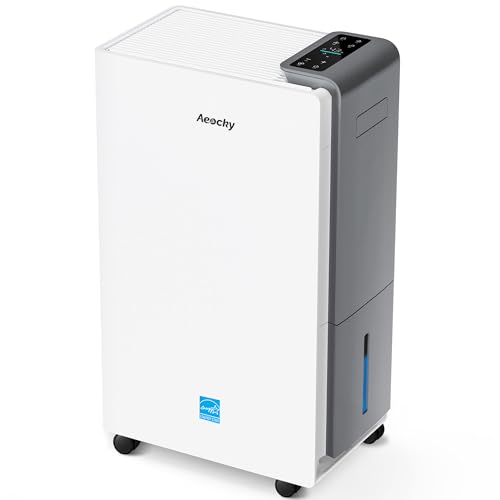
Dehumidifier with Pump Up to 16.5ft Energy Star Most Efficient 2025 AEOCKY
AEOCKY Dehumidifier with Pump Up to 16.5ft Energy Star Most Efficient 2025 — rated 4.5/5 from 7619 reviews, currently 5% off. 20% commission via PartnerBoost.
Rated 4.5 from 7619 buyers
5% off list price
Specs come from the listing title and may omit detail
Capacity figures are manufacturer claims, not independently verified
Skip it if: Check the sizing arithmetic on this page against your own room before buying. Listed capacity claims are manufacturer figures taken at favourable test conditions.
Prices and availability are accurate as of the date and time shown and are subject to change. Any price and availability information displayed on the retailer's site at the time of purchase will apply to the purchase of this product.
 2
5500 Sq.Ft Energy Star Most Efficient 2025 Dehumidifier for Basement AEOCKY
AEOCKY 5500 Sq.Ft Energy Star Most Efficient 2025 Dehumidifier for Basement — rated 4.5/5 from 7619 reviews, currently 7% off. 20% commission via PartnerBoost.
Rated 4.5 from 7619 buyers
7% off list price
Specs come from the listing title and may omit detail
Capacity figures are manufacturer claims, not independently verified
Skip it if: Check the sizing arithmetic on this page against your own room before buying. Listed capacity claims are manufacturer figures taken at favourable test conditions.
Prices and availability are accurate as of the date and time shown and are subject to change. Any price and availability information displayed on the retailer's site at the time of purchase will apply to the purchase of this product.
 3
50 Pint/Day, 3500Sq.Ft Ultra-Quiet 40dB Dehumidifier with Drain Hose AEOCKY
AEOCKY 50 Pint/Day — rated 4.3/5 from 1373 reviews, currently 10% off. 20% commission via PartnerBoost.
Rated 4.3 from 1373 buyers
10% off list price
Specs come from the listing title and may omit detail
Capacity figures are manufacturer claims, not independently verified
Skip it if: Check the sizing arithmetic on this page against your own room before buying. Listed capacity claims are manufacturer figures taken at favourable test conditions.
Prices and availability are accurate as of the date and time shown and are subject to change. Any price and availability information displayed on the retailer's site at the time of purchase will apply to the purchase of this product.
How these numbers were derived
We do not claim hands-on testing. Every figure here traces to a published standard or a documented calculation: the DOE test conditions in force since June 2019 for dehumidifier capacity, and the air-changes-per-hour convention for purifier coverage. Where industry practice and manufacturer claims diverge, we show both numbers rather than picking the flattering one.
If you find an error in the arithmetic, it is shown above so you can point at the exact step. We would rather be corrected than be confidently wrong.
Frequently asked questions
How many pints do I need for a 1,000 square foot basement?
About 42 pints at a standard 8 ft ceiling in moderate humidity, which means buying a 50-pint unit. The 1,000 sq ft figure alone is not enough to size it — a 7 ft ceiling needs less and a 10 ft ceiling needs more.
Is a bigger dehumidifier always better?
Up to a point, yes. An oversized unit reaches your target humidity faster and then cycles off, which is more efficient than a small unit running continuously. But past roughly 1.5 times what your space needs, you are paying for capacity that will never run.
Why is my 50-pint dehumidifier removing less than 50 pints?
The rating assumes 65°F and 60% relative humidity. Below that temperature a compressor-based unit extracts noticeably less water, and if your basement sits at 55°F you may be getting closer to 30 pints of real removal.
Should I size by square feet or cubic feet?
Cubic feet, always. A room with a 10 ft ceiling holds 25% more air than the same floor area at 8 ft, and the dehumidifier has to dry all of it. Manufacturer square-foot claims almost always assume a standard ceiling.