





Short answer
Add up each appliance's watts × hours × duty cycle to get daily watt-hours, multiply by the days you need to cover, then divide by 0.765 to convert usable energy into the nominal capacity printed on the box. A fridge, router, four lights and two phones for one day needs about 1,010 Wh usable — which means buying a 1,321 Wh unit, not a 1,000 Wh one.
The part most guides skip
Two numbers decide whether a power station works, and buyers only check one. Capacity decides how long it runs; continuous AC output decides whether it runs at all. A 1,500 W kettle on a 1,000 W inverter trips instantly no matter how many watt-hours sit behind it. Size the inverter first, then the battery.
What capacity do you actually need?
Pick what you want to run and for how long. The result shows the nominal capacity you must buy, not just the usable energy you need — those are not the same number.
What will you run?
You must buy (nominal)
2,217Wh
to deliver 1,696 Wh of usable energy
- Daily use
- 1,696 Wh
- Peak if all on
- 204 W
Assumes 90% depth of discharge and 85% inverter efficiency — the two losses every lithium unit has. Fridge assumes a 35% duty cycle. Add 20% margin if you will also charge phones and run lights you have not listed.
The formula behind the calculator
Everything above comes from one chain of arithmetic. Get this straight and you can check any calculator, including ours.
Step 1 — daily energy. For each appliance: watts × hours × duty cycle. A fridge rated 150 W that runs 24 hours at a 35% duty cycle uses 150 × 24 × 0.35 = 1,260 Wh per day.
Step 2 — total for the outage. Multiply by days. Two days of that fridge is 2,520 Wh.
Step 3 — usable to nominal. Divide by 0.765. 2,520 ÷ 0.765 = 3,294 Wh nominal.
Step 3 is the one everybody skips, and it is why people buy a unit that runs flat six hours early.
The 0.765 figure is 90% depth of discharge × 85% inverter efficiency. Both are averages across the units we track. Some models publish their own figures — where they do, their product page uses those instead.
The second number: continuous AC output
Capacity answers "for how long". Continuous AC output answers "at all". They are separate specs and both can fail you.
A resistive load (kettle, heater, microwave) draws its nameplate wattage the moment you switch it on. There is no ramp-up and no tolerance — if the inverter is rated below it, the protection circuit trips.
A motor load (fridge, fan, pump) is worse: it draws three to five times its running wattage for a fraction of a second at startup. That spike is why stations publish a "peak" or "surge" rating alongside the continuous one.
| Load | Running watts | Startup spike | What to check |
|---|---|---|---|
| LED lights, router, phone | 10–35 W | None | Nothing — any unit works |
| Laptop, TV, fan | 60–100 W | 1–1.5× | Continuous rating |
| Fridge | 150 W | 3–5× | Peak rating, not continuous |
| CPAP | 60 W | Only if heated humidifier | Continuous + humidifier watts |
| Microwave | 1,000 W | 1.5× | Peak rating above 1,500 W |
| Kettle, space heater | 1,500 W | None (resistive) | Continuous rating above 1,500 W |
A fridge that lists 150 W can pull 600 W for a second when the compressor starts. If the station's peak rating is 1,000 W, you are fine. If it only publishes a continuous 500 W and no peak figure, assume it will trip.
The duty cycle, and why it changes everything
A fridge is not a 150 W appliance. It is a 150 W appliance that runs about a third of the time. Treating it as continuous triples your requirement and pushes you toward a unit twice as large as you need.
The same is true of a well-insulated house's heating, a dehumidifier with a humidistat, and a compressor-style water cooler. Anything with a thermostat has a duty cycle.
The calculator uses 35% for a fridge — a reasonable average for a modern unit in a normal room. In a hot garage it climbs toward 50%, so if your fridge lives somewhere warm, add a day of margin.
| Appliance | Duty cycle | Why |
|---|---|---|
| Modern fridge | ~35% | Compressor cycles on temperature |
| Older / garage fridge | ~50% | Poor insulation, hotter ambient |
| Chest freezer | ~30% | Better insulation, less door opening |
| Dehumidifier (humidistat) | ~55% | Cycles on humidity target |
| Space heater (thermostat) | ~35% | Cycles on temperature |
After the number: what to look for
Once you know the nominal capacity, the buying decision reduces to three checks, in this order:
- Peak AC output must exceed your largest startup spike. This is a hard gate — fail it and the capacity is irrelevant.
- Capacity must exceed the calculator's figure, with your own margin added.
- Solar input decides how fast you recover in a long outage — see why solar is slower than the label.
To compare candidates on value rather than sticker price, use price per usable Wh — it normalises capacity, efficiency and price into one number.
Buy for the outage you actually expect to have, not the worst one imaginable. A unit sized for a three-day winter storm will be too heavy to move when you need it for a two-hour outage.
Units that meet this spec
Each pick states the situation where it is the wrong buy. Nothing here is recommended for every room, and the cheapest option is included where it is genuinely the right one.
 1
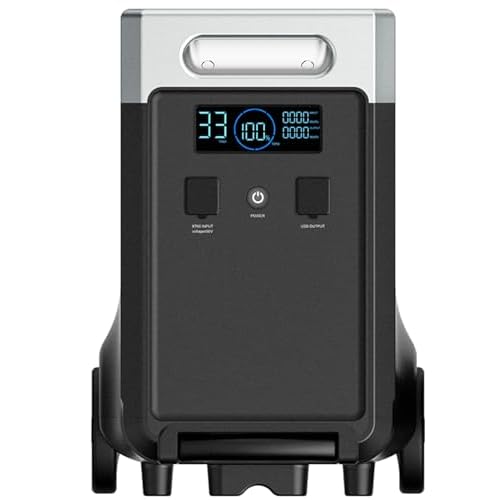
SOLIX C2000 Gen 2 Solar Powered Generator 2,048Wh, 2,400W, Camping Anker
Anker SOLIX C2000 Gen 2 Solar Powered Generator 2 — rated 4.7/5 from 768 reviews, currently 36% off. 3% commission via PartnerBoost.
Rated 4.7 from 768 buyers
36% off list price
Specs come from the listing title and may omit detail
Capacity figures are manufacturer claims, not independently verified
Skip it if: Check the sizing arithmetic on this page against your own room before buying. Listed capacity claims are manufacturer figures taken at favourable test conditions.
Prices and availability are accurate as of the date and time shown and are subject to change. Any price and availability information displayed on the retailer's site at the time of purchase will apply to the purchase of this product.
 2
P310 Expansion Battery Pack, Add 3840Wh LiFePO4 Extra Capacity AFERIY
AFERIY P310 Expansion Battery Pack — rated 4.4/5 from 234 reviews, currently 10% off. 5% commission via PartnerBoost.
Rated 4.4 from 234 buyers
10% off list price
Specs come from the listing title and may omit detail
Capacity figures are manufacturer claims, not independently verified
Skip it if: Check the sizing arithmetic on this page against your own room before buying. Listed capacity claims are manufacturer figures taken at favourable test conditions.
Prices and availability are accurate as of the date and time shown and are subject to change. Any price and availability information displayed on the retailer's site at the time of purchase will apply to the purchase of this product.
 3
SOLIX C1000 Gen 2 Solar Powered Generator Anker
Anker SOLIX C1000 Gen 2 Solar Powered Generator — rated 4.6/5 from 1803 reviews, currently 33% off. 3% commission via PartnerBoost.
Rated 4.6 from 1803 buyers
33% off list price
Specs come from the listing title and may omit detail
Capacity figures are manufacturer claims, not independently verified
Skip it if: Check the sizing arithmetic on this page against your own room before buying. Listed capacity claims are manufacturer figures taken at favourable test conditions.
Prices and availability are accurate as of the date and time shown and are subject to change. Any price and availability information displayed on the retailer's site at the time of purchase will apply to the purchase of this product.
How these numbers were derived
We do not claim hands-on testing. Every figure here traces to a published standard or a documented calculation: the DOE test conditions in force since June 2019 for dehumidifier capacity, and the air-changes-per-hour convention for purifier coverage. Where industry practice and manufacturer claims diverge, we show both numbers rather than picking the flattering one.
If you find an error in the arithmetic, it is shown above so you can point at the exact step. We would rather be corrected than be confidently wrong.
Frequently asked questions
Why is the required nominal capacity higher than the energy I need?
Because two losses sit between the cell and your appliance. Every lithium pack holds back about 10% to avoid deep discharge, and the inverter loses roughly 15% turning DC into AC. Together they leave you 0.9 × 0.85 = 76.5% of the printed capacity.
Should I add a safety margin on top?
Yes — roughly 20% if you will also charge phones, run lights you did not list, or if the weather is cold. Cold reduces usable capacity in most lithium chemistries, and no calculator can predict how cold your garage gets in January.
How do I know the fridge's real draw?
Nameplate wattage is the worst case. A fridge compressor cycles: it draws its rated watts perhaps 35% of the time and almost nothing in between. That is why this calculator multiplies fridge hours by a 0.35 duty cycle. Using nameplate watts for a full 24 hours overstates the need by roughly three times.
Do I need the same capacity for a CPAP as for a fridge?
The CPAP needs far less. A typical machine draws 60 W for 8 hours = 480 Wh, while the fridge at 150 W × 24 h × 0.35 = 1,260 Wh. But check the CPAP's startup draw: some models spike briefly, and a heated humidifier adds another 100–200 W.