





Short answer
A 50-pint dehumidifier running 12 hours a day at a 55% duty cycle uses about 1,036 kWh a year, which costs roughly $176 at the US average of $0.17/kWh. Across a six-month wet season that is about $88. The two biggest levers are how many hours it runs and how inefficient the unit is — a 620W model costs about 44% more to run than a 430W model of the same capacity.
The part most guides skip
Pints per watt, not pints alone, predicts your bill. Two 50-pint units can differ by 190W, which is $54 a year at 12 hours a day — enough to erase a $100 price advantage in under two years.
The formula, and the numbers to plug into it
Every estimate on this page comes from one equation: watts ÷ 1000 × hours per day × 365 × duty cycle × your rate per kWh.
The duty cycle is the part people miss. A dehumidifier does not run its compressor constantly — it cycles on when humidity rises and off when target is reached. In a genuinely wet space that cycle sits around 55%; in a dry, well-sealed room it can fall to 30%.
If you use the rated wattage without a duty cycle, you will overestimate your bill by nearly double.
| Capacity | Typical draw | 12h/day @ 55% | 24h/day @ 55% |
|---|---|---|---|
| 20 pint | 300 W | ~$123 | ~$246 |
| 35 pint | 380 W | ~$156 | ~$311 |
| 50 pint | 460 W | ~$188 | ~$377 |
| 70 pint | 620 W | ~$254 | ~$507 |
These assume the unit runs year-round. Most people run a basement dehumidifier for six to eight months, so halve the figures for a realistic seasonal cost.
Why the wattage gap between models matters more than price
Two 50-pint dehumidifiers can differ by 190W. At 12 hours a day and 55% duty cycle, that is 458 kWh a year, or about $78 at average US rates.
A $100 price advantage disappears in under 18 months. This is why we list watts on every card rather than only the pint rating.
The efficient unit is not always the more expensive one, either. Some mid-priced models beat premium ones on pints per watt, because the premium is spent on features like pumps and app control rather than compressor efficiency.
| 50-pint model | Watts | Pints/W | 3-yr power cost |
|---|---|---|---|
| Efficient | 430 W | 0.116 | ~$480 |
| Average | 500 W | 0.100 | ~$558 |
| Inefficient | 620 W | 0.081 | ~$692 |
Divide pints by watts before you buy. Anything at or above 0.11 is good for a compressor unit. Below 0.09, you are paying for that inefficiency every month.
The four things that actually move your bill
Hours run. This is the biggest lever and the one you control most directly. Going from 24 to 12 hours a day halves the cost — but only works if the space stays below 60% humidity on 12 hours.
Duty cycle. A well-sealed basement with a fixed moisture source cycles less than a leaky one. Air-sealing and fixing gutters can cut runtime more cheaply than any equipment upgrade.
Wattage. Fixed per model, so it is a purchase decision rather than an operating one.
Electricity rate. $0.12/kWh in parts of the Midwest versus $0.30 in Hawaii is a 150% difference on the same machine. Check your actual rate on your bill rather than assuming the national average.
When the dehumidifier costs more than the problem
A dehumidifier running continuously against an active leak will cost $200 to $400 a year in electricity and never solve the problem. That money is better spent on drainage, a sump pump, or sealing.
The signal is simple: if the unit never cycles off, it is losing to a moisture source. A correctly sized unit in a controlled space reaches target and rests.
This is the one case where our advice is to spend nothing on the appliance and fix the building instead.
A dehumidifier that runs 24/7 without reaching target humidity is not undersized — it is fighting a water source. Adding capacity makes the bill worse, not the problem better.
Wattage is the only spec that compounds
Purchase price is paid once. Wattage is paid every hour the device runs for as long as you own it, which is why it deserves more attention than it usually gets.
The formula is the same for everything: watts ÷ 1,000 × hours × your electricity rate. A 300 W dehumidifier running 12 hours a day at $0.17/kWh costs about $0.61 a day, or $224 a year.
What changes by category is the duty cycle. A dehumidifier cycles on and off; a purifier often runs continuously; a power bank's draw is trivial; a space heater is the single most expensive appliance most people own.
Always compute the annual figure. It is the only number that lets you compare across categories and against your actual budget.
Units that meet this spec
Each pick states the situation where it is the wrong buy. Nothing here is recommended for every room, and the cheapest option is included where it is genuinely the right one.
 1
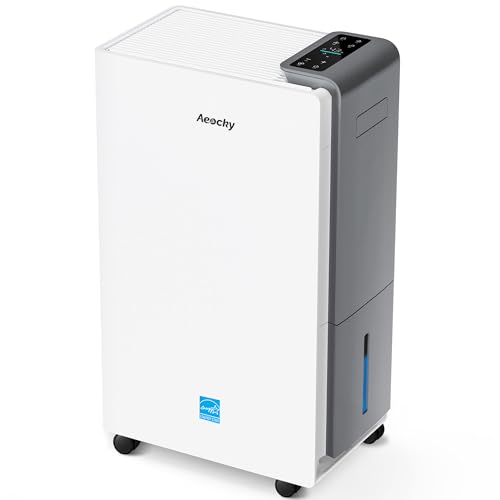
Dehumidifier with Pump Up to 16.5ft Energy Star Most Efficient 2025 AEOCKY
AEOCKY Dehumidifier with Pump Up to 16.5ft Energy Star Most Efficient 2025 — rated 4.5/5 from 7619 reviews, currently 5% off. 20% commission via PartnerBoost.
Rated 4.5 from 7619 buyers
5% off list price
Specs come from the listing title and may omit detail
Capacity figures are manufacturer claims, not independently verified
Skip it if: Check the sizing arithmetic on this page against your own room before buying. Listed capacity claims are manufacturer figures taken at favourable test conditions.
Prices and availability are accurate as of the date and time shown and are subject to change. Any price and availability information displayed on the retailer's site at the time of purchase will apply to the purchase of this product.
 2
5500 Sq.Ft Energy Star Most Efficient 2025 Dehumidifier for Basement AEOCKY
AEOCKY 5500 Sq.Ft Energy Star Most Efficient 2025 Dehumidifier for Basement — rated 4.5/5 from 7619 reviews, currently 7% off. 20% commission via PartnerBoost.
Rated 4.5 from 7619 buyers
7% off list price
Specs come from the listing title and may omit detail
Capacity figures are manufacturer claims, not independently verified
Skip it if: Check the sizing arithmetic on this page against your own room before buying. Listed capacity claims are manufacturer figures taken at favourable test conditions.
Prices and availability are accurate as of the date and time shown and are subject to change. Any price and availability information displayed on the retailer's site at the time of purchase will apply to the purchase of this product.
 3
50 Pint/Day, 3500Sq.Ft Ultra-Quiet 40dB Dehumidifier with Drain Hose AEOCKY
AEOCKY 50 Pint/Day — rated 4.3/5 from 1373 reviews, currently 10% off. 20% commission via PartnerBoost.
Rated 4.3 from 1373 buyers
10% off list price
Specs come from the listing title and may omit detail
Capacity figures are manufacturer claims, not independently verified
Skip it if: Check the sizing arithmetic on this page against your own room before buying. Listed capacity claims are manufacturer figures taken at favourable test conditions.
Prices and availability are accurate as of the date and time shown and are subject to change. Any price and availability information displayed on the retailer's site at the time of purchase will apply to the purchase of this product.
How these numbers were derived
We do not claim hands-on testing. Every figure here traces to a published standard or a documented calculation: the DOE test conditions in force since June 2019 for dehumidifier capacity, and the air-changes-per-hour convention for purifier coverage. Where industry practice and manufacturer claims diverge, we show both numbers rather than picking the flattering one.
If you find an error in the arithmetic, it is shown above so you can point at the exact step. We would rather be corrected than be confidently wrong.
Frequently asked questions
How much does it cost to run a dehumidifier per day?
A 50-pint unit running 12 hours at a 55% duty cycle draws about 2.84 kWh a day, which costs around $0.48 at $0.17/kWh. A smaller 20-pint unit costs closer to $0.20 a day.
Do dehumidifiers use a lot of electricity?
Comparable to a small window air conditioner — between 300W and 700W while the compressor runs. Because the compressor cycles on and off, actual consumption is lower than the rated wattage suggests.
Is it cheaper to run a dehumidifier at night?
Only if your utility offers time-of-use rates. On a flat rate, when you run it makes no difference to the total. On a time-of-use plan, shifting to off-peak hours can cut the cost per kWh by half or more.
What uses more power, a dehumidifier or an air purifier?
A dehumidifier, by a wide margin. A typical purifier draws 25 to 105W, while a dehumidifier draws 300 to 700W because it runs a compressor. A purifier costs about $37 a year to run continuously; a dehumidifier costs 4 to 5 times that.