


Short answer
A 400W panel realistically delivers about 983Wh per day in summer and 693Wh per day in winter — 78% and 55% of a naive 400W × 6 hours calculation. Recharging a 3,014Wh station that way takes 3.1 days in summer and 4.3 in winter. A 10kWh home battery takes 10 days in summer and 14.5 in winter. Solar input on a power station is a trickle charge, not a refill.
Models mentioned above
The part most guides skip
The rating on a solar panel is measured at 25°C under 1,000 W/m² of irradiance with the panel perpendicular to the sun. A panel bolted flat to a roof or propped at a fixed angle on a campsite never sees those conditions. The three losses compound: sun angle (~75%), panel temperature (a hot panel loses 10–15% of its output), and cable plus charge-controller loss (~90% pass-through). That is where the other half of your 400W goes.
The three losses between the label and your battery
A solar panel's wattage is measured under standard test conditions: 1,000 W/m² irradiance, 25°C cell temperature, no shading, no cable. Every one of those is optimistic in real use.
Sun angle is the largest. A fixed panel only faces the sun exactly at one moment of the day. Averaged over a day, you collect noticeably less than the perpendicular case — this is what 'peak sun hours' already accounts for, and why a 400W panel does not produce 400W × 12 daylight hours.
Cell temperature is the one people miss. Panels lose roughly 0.35–0.45% of output per °C above 25°C. A dark panel in summer sun sits at 55–65°C, which is a further 10–15% gone.
Cable and controller losses take another 5–12%. Everything compounds multiplicatively, which is why the final number looks so much smaller than the sticker.
| Stage | Remaining output | What removed it |
|---|---|---|
| Rated (STC) | 400 W | — |
| After sun angle over a day | ~290 W avg | Panel is only perpendicular once daily |
| After heat derating | ~250 W | Cell at 55–65°C in direct sun |
| After cable + controller | ~225 W | Resistance and conversion loss |
| × 4.2 peak sun hours | ~945 Wh/day | Summer, clear, correctly angled |
The 4.2 peak-sun-hour figure is a summer average for the continental US. In winter it drops to roughly 2.5, which is why the same panel collects about 30% less energy in December than in June.
What that means for actual recharge times
Now apply the daily yield to the stations we track. This is the number that decides whether solar is a real plan or a camping fantasy.
Note what happens at the large end: a 10kWh home battery charged only by a 400W panel is effectively never full. If your outage is three days, the panel contributes about 3kWh — less than a third of the pack.
| Station size | Summer (983 Wh/day) | Winter (693 Wh/day) |
|---|---|---|
| 1,024 Wh (C1000 class) | 1.0 day | 1.5 days |
| 2,048 Wh (C2000 class) | 2.1 days | 3.0 days |
| 3,014 Wh (Elite 300 class) | 3.1 days | 4.3 days |
| 3,840 Wh (P310 class) | 3.9 days | 5.5 days |
| 10,017 Wh (TITAN class) | 10.2 days | 14.5 days |
These assume no load is running while charging. Recharge a station while it is powering a fridge at 150W average and you are consuming ~3.6kWh/day — more than a single 400W panel produces in winter. The battery drains even with the panel connected.
The rule that decides your panel count
Work backwards from daily consumption, not from battery capacity. If your essentials draw 2kWh per day, you need panels that produce at least that much in the worst month you care about — so 2,000Wh ÷ 693Wh per 400W panel ≈ 3 panels.
Most people buy one panel and a large battery, which is the wrong proportion. The battery buys you time; the panels buy you independence. For a multi-day outage, panels are the variable that matters after day two.
There is an upper limit too: the charge controller caps input. A station with a 500W solar input will not accept a 1,200W array — the extra panels are wasted money. Check the input limit before buying panels, not after.
| Daily draw | Panels for summer | Panels for winter |
|---|---|---|
| 0.7 kWh (router + phones + laptop) | 1 | 1 |
| 1.5 kWh (add a fridge) | 2 | 3 |
| 2.5 kWh (add TV, lights, fan) | 3 | 4 |
| 4.0 kWh (add a CPAP, more fridge) | 5 | 6 |
What to check before you buy panels
Match the array to the input limit, not to the biggest panel on sale. Oversizing the array past the controller's ceiling wastes money and buys nothing.
Check the input voltage window. Panels connected in series add voltage; if the string exceeds the station's maximum input voltage, the controller shuts down or is damaged.
And check whether the panel folds. A 400W rigid panel is roughly 1.7 m² and impossible to move alone; a 200W folding panel is portable but produces half as much. Two 200W folding panels usually beat one 400W rigid panel for anyone who is not installing it permanently.
Before buying any panel, look at the station's spec sheet for two numbers: maximum solar input in watts, and maximum input voltage. Those two decide which panels are compatible. Capacity and panel wattage alone do not.
Units that meet this spec
Each pick states the situation where it is the wrong buy. Nothing here is recommended for every room, and the cheapest option is included where it is genuinely the right one.
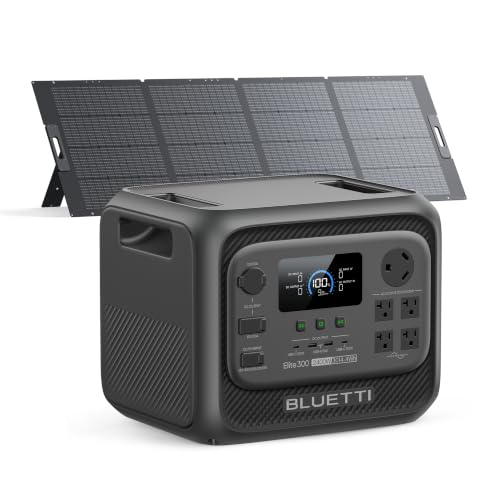 1
Solar Generator Elite 300 with 350W Solar Panel Included, 3014.4Wh BLUETTI
BLUETTI Solar Generator Elite 300 with 350W Solar Panel Included — rated 4.6/5 from 286 reviews, currently 10% off. 10% commission via PartnerBoost.
Rated 4.6 from 286 buyers
10% off list price
Specs come from the listing title and may omit detail
Capacity figures are manufacturer claims, not independently verified
Skip it if: Check the sizing arithmetic on this page against your own room before buying. Listed capacity claims are manufacturer figures taken at favourable test conditions.
Prices and availability are accurate as of the date and time shown and are subject to change. Any price and availability information displayed on the retailer's site at the time of purchase will apply to the purchase of this product.
 2
Solar Generator Elite 300 & 500W Solar Panel 3014.4Wh LFP Battery BLUETTI
BLUETTI Solar Generator Elite 300 & 500W Solar Panel 3014.4Wh LFP Battery — rated 4.6/5 from 286 reviews, currently 26% off. 10% commission via PartnerBoost.
Rated 4.6 from 286 buyers
26% off list price
Specs come from the listing title and may omit detail
Capacity figures are manufacturer claims, not independently verified
Skip it if: Check the sizing arithmetic on this page against your own room before buying. Listed capacity claims are manufacturer figures taken at favourable test conditions.
Prices and availability are accurate as of the date and time shown and are subject to change. Any price and availability information displayed on the retailer's site at the time of purchase will apply to the purchase of this product.
 3
SOLIX C1000 Gen 2 Solar Powered Generator Anker
Anker SOLIX C1000 Gen 2 Solar Powered Generator — rated 4.6/5 from 1803 reviews, currently 33% off. 3% commission via PartnerBoost.
Rated 4.6 from 1803 buyers
33% off list price
Specs come from the listing title and may omit detail
Capacity figures are manufacturer claims, not independently verified
Skip it if: Check the sizing arithmetic on this page against your own room before buying. Listed capacity claims are manufacturer figures taken at favourable test conditions.
Prices and availability are accurate as of the date and time shown and are subject to change. Any price and availability information displayed on the retailer's site at the time of purchase will apply to the purchase of this product.
How these numbers were derived
We do not claim hands-on testing. Every figure here traces to a published standard or a documented calculation: the DOE test conditions in force since June 2019 for dehumidifier capacity, and the air-changes-per-hour convention for purifier coverage. Where industry practice and manufacturer claims diverge, we show both numbers rather than picking the flattering one.
If you find an error in the arithmetic, it is shown above so you can point at the exact step. We would rather be corrected than be confidently wrong.
Frequently asked questions
How many peak sun hours should I use?
Four to five for most of the continental United States in summer, two to three in winter. 'Peak sun hours' already accounts for the sun not being directly overhead all day — it is not the same as daylight hours, which are longer.
Why does my 400W panel only show 250W on the app?
Three common reasons: the panel is not perpendicular to the sun, the panel is hot (output drops with temperature), or the charge controller is limiting current. Check at local solar noon on a cool clear day with the panel angled toward the sun — that is the only moment the rating is even theoretically reachable.
Do I need more panels or a bigger battery?
It depends on which one is the bottleneck. If you can recharge fully in one day, more panels add nothing. If a full recharge takes four days, the panels are the bottleneck and the battery size is irrelevant to how fast you recover.
Does solar still make sense for emergency backup?
For long outages, yes — a grid outage is exactly when you cannot recharge from mains. But plan on days, not hours. For the first 24 hours of an outage, the battery you already have matters far more than the panel.