





Short answer
A basement needs a larger dehumidifier than its square footage suggests, because ceilings are often 7 ft or lower and temperatures sit below the 65°F test condition. A 1,000 sq ft basement at 7 ft and 58°F typically needs a 50-pint unit rated for cold operation, not the 35-pint unit the square footage implies. Air purification is usually secondary to moisture control.
The part most guides skip
Fix water before buying equipment. A dehumidifier running against a weeping wall will run continuously and never reach target, costing more in electricity than the repair would.
Three basement factors that break standard sizing
Lower ceilings mean less air but also throw off square-footage tables that assume 8 ft. A 7 ft ceiling means 12.5% less volume than the same floor area at 8 ft, and a 6 ft crawl-height space much less again.
Lower temperatures mean the 65°F rating condition is optimistic. At 55°F a compressor unit extracts substantially less water, and the gap widens as temperature falls.
Ongoing moisture means the calculation's assumption of a sealed space is wrong. A weeping wall adds water continuously, and no capacity rating accounts for it.
Cold basements need the right technology, not just more capacity
Compressor dehumidifiers condense water on a chilled coil. As air temperature drops, the coil's ability to pull moisture out falls with it, and units begin frosting and cycling into defrost mode.
Desiccant dehumidifiers use a rotating wheel coated in desiccant material and hold their capacity much better in cold conditions. They cost more to run, because they use a heater to regenerate the wheel.
The trade-off is straightforward: if your basement stays above 60°F, a compressor unit is more efficient. Below that, especially around 50°F, a desiccant or a hot-gas-bypass compressor unit is the correct choice regardless of price.
Check the minimum operating temperature on the spec sheet before buying for a cold basement. Many units list 41°F as the floor, but their effective output declines well before that.
Drainage is the feature that decides whether you keep using it
In a wet basement a 50-pint unit can produce two gallons a day. A bucket means a daily chore, and the machine ends up switched off within a month.
Gravity drain through a garden hose works if you have a floor drain or a sump pit at a lower level. Most basement dehumidifiers accept a standard hose fitting.
If no gravity path exists, a built-in pump is essential. It lifts condensate up and out, which is the only option when the unit sits below the drain level.
Where purification fits
A basement smell is usually volatile organic compounds and mold spores riding on high humidity. A purifier with a carbon layer can reduce the smell, but if humidity stays high, mold keeps producing new spores and the purifier runs continuously against a growing source.
Get humidity below 50% first. Then, if dust or allergens remain a problem, add a purifier sized at 5 air changes per hour for the actual volume.
For a 1,000 sq ft basement at 7 ft, that is 7,000 ft³, which needs CADR around 583 — larger than most consumer purifiers deliver. In practice that means either multiple units or accepting partial coverage near where you spend time.
The basement rule applies everywhere a room is buried
A basement is the hardest room in a house to keep dry because it is below grade: the soil around it stays near groundwater temperature, and moisture migrates through the slab and walls continuously.
The same reasoning applies to any below-grade or heavily shaded space — a cellar, a garage cut into a slope, a ground-floor room with a retaining wall on one side.
Above grade, the calculation changes: a bedroom needs air changes for freshness, a kitchen needs extraction for cooking moisture, a bathroom needs intermittent high-capacity ventilation.
The mistake is buying one machine for the whole house. Rooms fail differently, and the specs that matter differ accordingly.
Units that meet this spec
Each pick states the situation where it is the wrong buy. Nothing here is recommended for every room, and the cheapest option is included where it is genuinely the right one.
 1
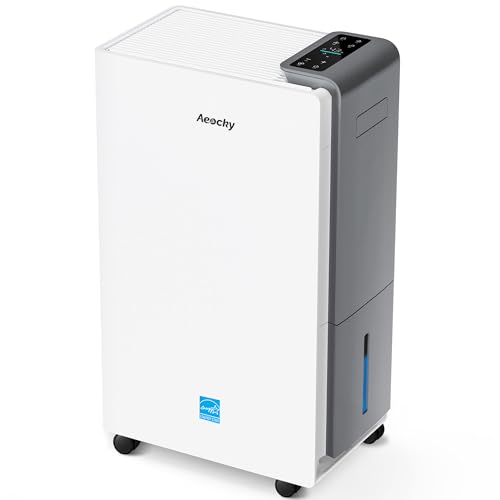
Dehumidifier with Pump Up to 16.5ft Energy Star Most Efficient 2025 AEOCKY
AEOCKY Dehumidifier with Pump Up to 16.5ft Energy Star Most Efficient 2025 — rated 4.5/5 from 7619 reviews, currently 5% off. 20% commission via PartnerBoost.
Rated 4.5 from 7619 buyers
5% off list price
Specs come from the listing title and may omit detail
Capacity figures are manufacturer claims, not independently verified
Skip it if: Check the sizing arithmetic on this page against your own room before buying. Listed capacity claims are manufacturer figures taken at favourable test conditions.
Prices and availability are accurate as of the date and time shown and are subject to change. Any price and availability information displayed on the retailer's site at the time of purchase will apply to the purchase of this product.
 2
5500 Sq.Ft Energy Star Most Efficient 2025 Dehumidifier for Basement AEOCKY
AEOCKY 5500 Sq.Ft Energy Star Most Efficient 2025 Dehumidifier for Basement — rated 4.5/5 from 7619 reviews, currently 7% off. 20% commission via PartnerBoost.
Rated 4.5 from 7619 buyers
7% off list price
Specs come from the listing title and may omit detail
Capacity figures are manufacturer claims, not independently verified
Skip it if: Check the sizing arithmetic on this page against your own room before buying. Listed capacity claims are manufacturer figures taken at favourable test conditions.
Prices and availability are accurate as of the date and time shown and are subject to change. Any price and availability information displayed on the retailer's site at the time of purchase will apply to the purchase of this product.
How these numbers were derived
We do not claim hands-on testing. Every figure here traces to a published standard or a documented calculation: the DOE test conditions in force since June 2019 for dehumidifier capacity, and the air-changes-per-hour convention for purifier coverage. Where industry practice and manufacturer claims diverge, we show both numbers rather than picking the flattering one.
If you find an error in the arithmetic, it is shown above so you can point at the exact step. We would rather be corrected than be confidently wrong.
Frequently asked questions
What size dehumidifier for a 1,000 sq ft basement?
Plan on 50 pints if the ceiling is 8 ft and moderate humidity, or 35 pints at a 7 ft ceiling. But if the basement runs below 60°F, choose a unit rated for cold operation rather than sizing up blindly — capacity at low temperature matters more than the rated pint figure.
Do I need an air purifier in a basement?
Usually as a second step. Musty basement smells are mostly a moisture problem, and a purifier will mask the smell without fixing the humidity. Control moisture first, then add purification if dust or allergens remain an issue.
Why does my basement dehumidifier run constantly?
Either the unit is undersized, the space is colder than the rating condition so the unit works harder for less output, or there is an ongoing water source. A unit that never cycles off is telling you one of those three things.